Where can worship leaders find wisdom for their leading?
 John Leach writes: The role of the 'worship leader' and the 'worship band' are relatively new on the church scene, coming into mainstream denominations with the rise of charismatic renewal from the 1960s. Before that a worship leader, at least in Anglican circles, was the government minister (often but non exclusively ordained) who led the congregation through whichever prayer book was existence used or, in costless church circles, who led throughout the whole act of worship. Only nowadays the term 'worship leader' usually refers to someone who stands at the front, guitar in hand, fronting a band of other musicians and leading the sung worship of the people. In some churches this grapheme is a paid member of staff, and is often called the 'worship pastor.'
With the growing popularity and visibility of this new part, resource and grooming have abounded. My new Grove booklet aims to explore whether there might be some wisdom to be gained in all of this from other disciplines, fifty-fifty ones which might at first seem unrelated, unnecessary or even hostile to this new world. It is an try to introduce into the thinking of those who are highly skilled with their guitars and songs, some other areas from which different but complementary skills might be acquired. I want to bring to the job of worship leading (every bit defined in a higher place) some insights from three unlike worlds—those of musicology, theology and liturgical studies—believing that they can and should provide wisdom which will make the whole worship-leading project richer.
Musicology is the academic study of music as a subject, as opposed to studying to sing, play or comport. Information technology is virtually how music works, what information technology does and what effects information technology can have on people. Like any academic field of study it has many subsections, but for our purposes I am concerned here with what joining in with music does to worshippers.
Music retentiveness concerns the past associations that particular music has for the listeners or performers. Even without the trauma, nosotros all the same associate music with other events and the emotions attached to them. That's how the 'Darling, they're playing our tune' factor works. Information technology is likely that some of the most significant hymns or songs for each of u.s.a. are significant not because of the wonderful tune or the powerful theology, merely because nosotros once sang them in a Big Top with 5,000 other people after a particularly powerful message, or because we had it at our hymeneals, or at the funeral of someone nosotros loved dearly. And, of course, as we rehear music, the sense that we know information technology well and that information technology is meaningful increases.
If music memory is so significant, one of the challenges is how to get the rest right between new songs and those nosotros already know. Sometimes worship leaders can feel under pressure to be constantly introducing new songs. Whilst there is adept scriptural warrant for 'singing a new song to the Lord,' in that location is no doubt that at least in part this is driven by less worthy motives, which have to exercise with the extremely lucrative business of what Pete Ward calls Selling Worship. I write just afterwards the death of my 95-year-old mother who right up to inside days of her death was nonetheless able to remember and join in with the traditional hymns of her younger years, equally well as some 1980s vintage worship songs, even if she could non e'er recall who I was. It could be that in today's fast-changing worship scene nosotros are in danger of giving the enthusiastic teenagers of today no ballast points for 70 years' time, musically, liturgically or spiritually. So there are immense implications at that place for our repertoire of songs. Does keeping in pace with the Spirit actually mean running quite that fast?
Some other trigger for emotions in worship is what is known as architectural pleasance, an overwhelming frisson of pleasance at the sheer cleverness of a musical result. Not anybody will be a ected every bit by this factor, merely many will. Some approaches to worship seek to strip away annihilation which might point to or glorify homo performance, because that would only draw attention away from the God on whom we are increasingly focusing. Simply perchance in doing so we are robbing at least some people of opportunities for pleasure, and I can merely say that for me please in human skill in the context of worship very apace leads me into praise to the creator of all that is artistic.
One of the main means in which music affects us is by edifice up tension, so resolving it in unlike ways. Musicologist L B Meyer notes that emotions are usually aroused when we discover we cannot answer to something in the ways nosotros might like to. And so if tension is built upward and resolution delayed we experience that event equally an emotional stimulus.At that place can exist keen delight in this tension and resolution dynamic, and it is particularly great to employ some of information technology during Advent.
To take this a little bit further, one important subsection of tension and resolution is the violation of people's expectations. There is much show to say that emotion is triggered when the music leads us to expect that information technology is going to do one thing, merely then suddenly does something else. There are several ways in which this can happen, just the common elements have to do with setting up the expectancy past doing something enough times, then to do something different, only to do information technology in a way which does make sense. That is why cathedral organists will frequently requite the hymn a lift by reharmonizing the last poetry, having played it directly for the previous verses.
Theology is an interesting term. For many churchgoers it conjures upwards images of academics in universities wasting time on obscure and pointless discussions, and for many Christians it refers to the domain of the professionals, that is clergy and ministers. Yet to get back to its literal meaning, 'words virtually (or the study of) God,' it is really maybe the near important thing the church tin can exist engaged in.
Those who serve in worship bands might not automatically consider that thinking theologically is a key part of their role, but one important truth ways that we just cannot leave theology out of worship leading. The fact is, as the cracking Methodist hymnwriters John and Charles Wesley knew simply too well, we acquire much of our theology through what we sing in worship. The words we put on our screens and into people's mouths will shape their understanding of God, and their relationship with him, to a much greater degree than will the sermons they hear or the Bible studies they join in. Stephen Land refers to charismatic songs as a major means of repetition and therefore reinforcement of belief in Pentecostal churches, and Anglicans believe specifically that their liturgy (if not their hymnody) enshrines their doctrine. If yous want to know what Anglicans believe, mind to how they worship.
In that location is a long tradition in the worlds of hymnody and song lyrics of setting scriptural texts to music, and of course many biblical texts (such every bit the psalms) would originally take been sung. But I think there has been a subtle shift in the way that we sing Scripture. In the recent by a scriptural vocal might take begun with one detail passage, and fix information technology to music. Just I detect in many more contemporary songs a different approach. Rather than setting the words of a passage to music, they bring together a (sometimes seemingly random) collection of different scriptural ideas and images gathered from a number of different biblical locations. This is biblical in one manner, but theologians would warn united states of america that when we take Bible passages (or ideas and images) out of context, we risk making them a pretext—that is, an excuse to say something that might not have been intended in the Bible itself. Neither does this approach help in the important fine art of memorizing Scripture.
One of the most helpful things that theology tin can teach u.s.a. is how to ask the correct critical questions of anything we are singing. 'Disquisitional' here is beingness used in a technical sense—it does not mean negative or judgmental; information technology ways analytical or reflective. In other words it means checking whether there might be other perspectives. A knowledge of theology tin can aid to give us a wider range of perspectives across those we bring from our own life experience and background.
To some worship leaders, the bailiwick of liturgical studies may feel less like drystone walling, and more than like suggesting that a skilled carpenter might accept something important to learn from the globe of IKEA flatpacking. Is not the whole thought of charismatic sung worship well-nigh liberating the church from the prepackaged uniformity of liturgical worship? What on earth could nosotros learn from the very earth of liturgy which it oftentimes feels similar nosotros have been led by the Spirit to leave behind?
Well, information technology depends what we mean by liturgy. If nosotros are referring simply to dull-sounding words out of a dusty volume that is one thing, but actually the subject field of liturgical studies is about a lot more than words on a page. At its best information technology is the written report of how worship works, how it can be well-ordered and helpful, and higher up all how information technology can help people connect with the living God, including thinking near what worship is, how the spontaneous relates to the well known, and the shape of the journey that worship takes usa on.
To engage with questions of liturgy, spend some time together equally a ring thinking about a worship gear up you have used recently. Spread the lyrics out in front of yous, and remember about the journey which worshippers were taken on through your set, both emotionally and theologically. How might this exercise inform your choice of songs for side by side time? How did the journey through the songs connect with the wider journey of the whole service?
If yous wanted to pb worship on Proficient Friday as though y'all had no idea what was coming in 3 days' fourth dimension, what songs might you employ?
What alternative sources might you explore in your quest for quality in words and music? How might you go about evaluating the words of songs, not just for their theology only also for their dazzler?
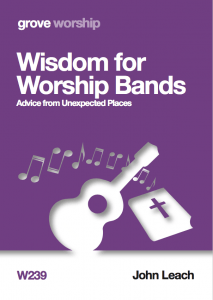 I hope that by listening to the voices of other disciplines y'all might be inspired to question, to rethink, to try going off in some different directions. If these extracts have whetted your appetite, then you can buy my Grove bookletWisdom for Worship Bands: Communication from Unexpected Placesfrom the Grove website for £3.95 postal service gratis in the UK, or as a PDF due east-book. The booklet includes fuller and in-depth exploration of each of these issues, questions for reflection for worship leaders and worship bands, and links to farther resources.
John Leach works in the Discipleship Team in the Diocese of Lincoln. He has been a parish priest for over twenty years, besides as a diocesan officer, Manager of Anglican Renewal Ministries, and an IKEA truck driver. He is currently researching for a doctorate apropos 'Anglican Vineyard' churches.
If y'all enjoyed this, exercise share information technology on social media, mayhap using the buttons on the left. Follow me on Twitter @psephizo.Like my folio on Facebook.
Much of my work is done on a freelance basis. If y'all have valued this post, would you considerdonating £1.20 a calendar month to support the production of this weblog?
If you enjoyed this, practice share it on social media (Facebook or Twitter) using the buttons on the left. Follow me on Twitter @psephizo. Similar my page on Facebook.
Much of my work is done on a freelance basis. If you have valued this post, you can make a single or repeat donation through PayPal:
For other ways to back up this ministry, visit my Back up folio.
Comments policy: Good comments that engage with the content of the post, and share in respectful contend, can add together real value. Seek first to understand, then to be understood. Make the nigh charitable construal of the views of others and seek to acquire from their perspectives. Don't view debate as a disharmonize to win; address the argument rather than tackling the person.
Source: https://www.psephizo.com/life-ministry/where-can-worship-leaders-find-wisdom-for-their-leading/
0 Response to "Where can worship leaders find wisdom for their leading?"
Publicar un comentario